Few folks would dare express public admiration for FIFA. Only newly beholden soccer association officials carrying suitcases full cash do that. In fact, open disdain for the Fédération Internationale de Football Association may be the only thing that unites proper fans in all 211 member nations. However, in its unquenchable lust for revenue, FIFA has stumbled into a purple-patch of decision-making this summer. Its 48-team World Cup tournament, newly expanded from the 32-team standard, is working. A field of 64 may work better still.

Know this: I had been dead set against this expansion. One just assumes that money-grubbing on the FIFA scale cannot be redeemed. Yet the first month has sobered up millions of 48-team skeptics like myself. Group-stage matches in the U.S., Canada and Mexico played out more like a final stage of qualifying — a surprisingly competitive, player-friendly, three-week introduction to knockout play, which suffered zero letdowns on account of the new Round of 32

Taken together, the entire tableau has proved better contested, more diverse, more deliberately executed, and more akin to a dreamy 6-week pop festival of world futbol. Whatever the politics dynamics, FIFA has achieved a critical mass of joy — in defiance of The Trump Junta’s churlish, cynical administrative behavior.

For all this, we should applaud the larger field.

Philosophically, FIFA’s decision to expand was about more television advertising dollars. But it dovetails logically with the novel notion of spreading tournaments across national borders. This is the first Mundial staged in multiple countries. In 2030, by conducting World Cup finals in Morocco, Portugal, Spain and Uruguay, FIFA will share a single tournament across three continents.

48-team World Cup? Prepare for 64

That competition will almost certainly feature 64 teams. Is it all a front to sell more potato chips? Maybe. In the meantime, even as we scorn FIFA and its leadership for shameless price-gauging (at the expense of match attendees) and revenue-hogging (at the expense of host cities), it’s only fair to spell out exactly what the larger field has wrought:

  • First and foremost, six to seven days rest between group games better serves player health and performance. After lengthy league seasons — some of which concluded only at the end of May — the new group-stage schedule proved a boon to recovery time. A week between fixtures is standard operating procedure for most domestic competitions around the world. The scheduling demands of 48 teams, in 12 separate groups, makes biological sense. The numbers bear thus out: Injuries were down and goals up: 2.99 mean goals per game, the highest since 1958, when young Pelé and Just Fontaine of France (13 goals!) sorta skewed that mean.
  • Second, let’s acknowledge that a 32-team tournament would have potentially denied places to Curacao, South Africa, Cape Verde, Egypt, Bosnia/Herzegovina, Scotland, Czechia, Ghana, Qatar, Sweden and everyone’s favorite underdog physician, Dr. Congo. Each of these “minnows” earned points against “bigger” soccer nations over three weeks of group play. Each advanced to World Cup 2026 via playoffs, or via the addition of continental slots stemming from the expansion to 48 teams. At Qatar 2022, for example, five sides qualified from Africa. This summer, nine did. Eight of them advanced to the knockout Round of 32!
  • Here’s another on-field bonus: These are national all-star teams, of course — “Dream” teams, to deploy a distinctly U.S. construct. Their rosters don’t play or train together for months and months at a stretch, only to be thrown together 7-10 days prior to major tournaments like this one. An extended group-play period, a direct byproduct of the 48-team field, has allowed managers and coaches to conduct actual training sessions where athletes can connect emotionally and tactically. This luxury also gives underdogs the opportunity to game-plan toward results that might otherwise elude them on short rest.

Would 64 teams come 2030 represent overkill? Three weeks ago, I’d have angrily spluttered, “Yes!” But I can’t do so today, not in good faith. With 16 groups of four, where only the top two finishers advance, the group phase eliminates half the field (along with all third-place finishers). I’m having a hard time manufacturing objections to something that so clearly raises the standards of play, tactics, endurance and fairness.

The Feel-Good Factor

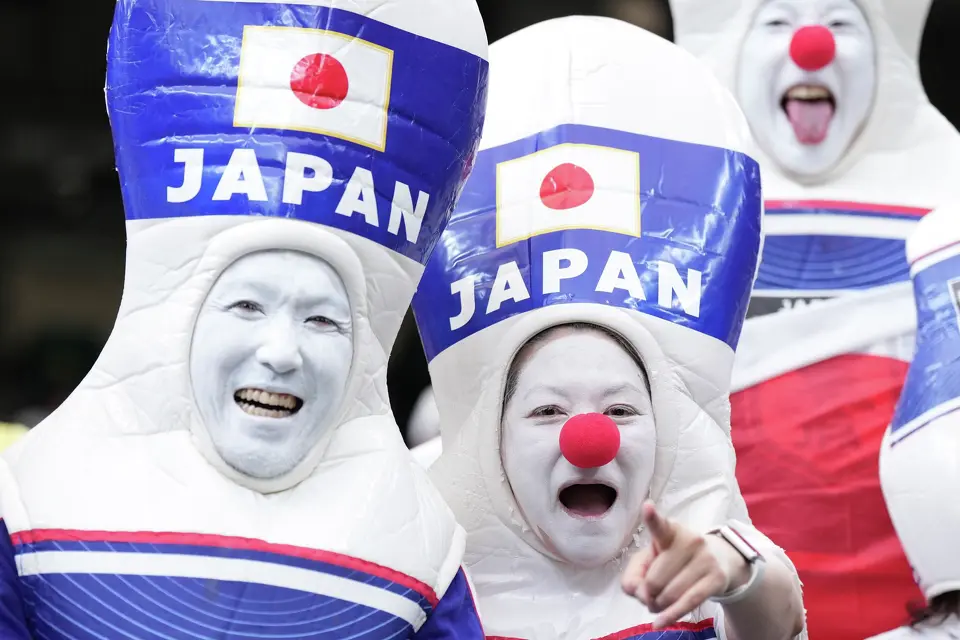
There’s something else these larger fields enable: sustained, carnival-level merry-making.

I flew back to Boston June 21 from the Netherlands, where I crossed paths with 100 Ghanaian fans at Schipol International Airport. They lit up our gate area in dress, song and pervasive good cheer. Mind you, a lot of authoritarian red tape had stood in their way. They partied through that hassle — and what a reward they received when the Black Stars held England and advanced to the knock-out stage.

Perhaps you’ve read or watched videos this month about Algerians being welcomed like family in Lawrence, Kansas; or the heartfelt meetings of futbol-supporting peoples with their respective state-side diasporas; or wide-eyed wonder of first-time Waffle House patrons; or the Japanese fans cleaning up stadium sections before exiting; or maybe the June 19 Egypt v. Iran match, staged concurrently in Seattle with the city’s Pride celebration.

Two feel-good corollaries apply here: 1) The more the merrier, and 2) the U.S. has benefitted directly from this infusion of diversity and joy. In a 32-team tournament, 50 percent of these teams and their respective entourages aren’t even here, and they go home sooner.

As John Oliver made hilariously clear, back in 2014, FIFA and its leadership team remain beyond moral redemption. Lucky for us, what FIFA is selling — the World Cup, not its World Club Championship (ew) — cannot be desecrated or degraded. Sometimes more is better, and here we can deploy a specific to prove the larger point: If a 64-team field virtually guarantees the participation of Scotland and its Tartan Army, meaning more en masse renditions of Abba tunes in random baseball stadia, I say “Yes. More of that, please.”