Bloomsbury issues Sibling Rivalry: The ESSENTIAL Soccer Book for 2026
Bloomsbury issues Sibling Rivalry: The ESSENTIAL Soccer Book for 2026
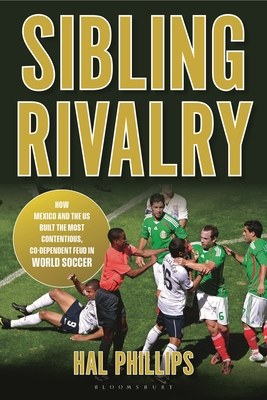
NEW YORK, N.Y. (5 March 2026) — Bloomsbury has published the latest release from best-selling author Hal Phillips. Sibling Rivalry: How Mexico and the US Built the Most Contentious, Co-Dependent Feud in World Soccer arrives 89 years after their first meeting, 35 years after Bora Milutinovic recast the North American Derby as a battle of equals, and 96 days before the two siblings co-host the 2026 World Cup, alongside Kid Brother Canada.
In Sibling Rivalry, Phillips investigates the intense, complex associations between the US and Mexico, on and off the field. Wielding meticulous, vigorous prose, the author sifts through all the epic matches, the complicated border dynamics, the countries’ economic and cultural interdependence, and the evolution of a one-sided nothing-burger of a derby into an intensely equal, ever-escalating athletic saga.
“I also explore the idea of rivalry itself,” Phillips explains. “I never thought of it this way, not until I did the research, but rivalry is actually a form of intimacy — and it’s remarkably co-dependent. You can’t conduct a proper derby without a foil. Turns out that, psychologically, you can’t keep one going without requisite doses of envy and scorn, either. And US vs. Mexico is unique among international rivalries because it features heaping helpings of envy and scorn going in both directions!
“I’m not sure that, today, one can understand the ever more fraught relationship between Mexico and the US without understanding the clásico the two sides have built. Like the rivalry itself, this book isn’t ‘about soccer.’ It’s about identity, migration, power, shared culture and history, envy and scorn, flat-out resentment, fear-mongering politics and ultimately interdependence, where, it turns out, soccer is the most emotionally accessible delivery system.”
Sibling Rivalry: Chock full of provocative, timely themes:
- Why the US but especially El Tri were never going to progress as footballing nations until the Americans proved a rival of quality. For Mexico in particular, it took a World Cup trauma in 2002 to make this bitter pill go down.
- Bora Milutinovic refashioned the USMNT as a worthy rival, but just as important: His move from Mexico to the US (and back again) opened a portal that still connects the two soccer communities. Today, it’s the players who move back and forth.
- The Dos a Cero! era in Columbus, Ohio, is over. So is Peak Azteca: El Tri have not beaten the US there since 2013. We should not be surprised. In a family — in rivalries between siblings — the idea of home-field advantage remains elusive at best.
- Traditionally, US sports are largely domestic in scope. Soccer is the outlier. Over the last four decades and counting, this rivalry has demonstrated to Americans how national teams work, how national sporting identity works, and how spicy international competition can be.
Phillips brings to life these stories and themes with help from dozens of players, coaches and media pundits on both sides of the border. He also draws on the experiences of Mexican Americans who live here but root for El Tri, who were born and raised here but opted to play for Mexico, or not. Their perspectives animate the idea that The North American Derby is shaped as much by migration as by match results.
Choosing Between Ambition and Heritage
“I was amazed to learn how many young, Latina fans process the rivalry,” the author says. “The USWNT has proved a massive cultural force for young women across the country, regardless of ethnicity. Mexican American women back them in huge numbers. But El Tri feminil has improved. It beat the US in March 2024, and that result really rocked their world. Many Mexicanas were obliged to make difficult choices between their heritage and the larger soccer culture where they live and play and consume the game day to day.
“It’s nearly the same choice national team prospects make year after year, in their hundreds. This dynamic, where young Mexican American men and women must choose between identity and opportunity, is excruciating. But it juices the rivalry, on field and off, in extraordinary ways. US-Mexico is one of the few derbies where history, migration and identity actually matter on the field. The grandfather of El Tri legend Rafa Marquez famously went north in the 1960s — and never came back. His grandson has not yet forgiven him.”
Even today, when immigration from Mexico makes bigger and bigger headlines, more than a million people and 300,000 goods-bearing vehicles traverse the US-Mexico border, north and south, every day. The two countries and their people remain intricately intertwined, whether they want to be or not. That’s what makes this centuries-old family drama, teased out in fascinating detail in Sibling Rivalry, so compelling.
“It’s the co-dependence that resonates with me,” Phillips says. “In futbol and so many other respects, we really do need each other — despite what certain politicians keep telling us. And, of course, we’re also stuck with each other. This rivalry is a messy, unmanageable inheritance. But you can’t take your eyes off it.”
Praise for Sibling Rivalry:
“Phillips gives us an important history lesson, not just on the US-Mexico soccer rivalry and the evolution of the sport in both countries, but on the interdependence between neighboring nations.”
— Paul Kennedy, Soccer America
“Phillips’s take on the complex US-Mexico soccer rivalry is nuanced, layered, and deeply felt. Top-notch storytelling for anyone interested in understanding what is really going on beneath the surface whenever the US men line up against El Tri.”
— Ty Keough, US National Team veteran and Mexican American
“I cannot find the proper words of praise and delight that I felt having read in one fell swoop Hal Phillips’s magisterial work on the US-Mexico rivalry in soccer. This is not only a masterpiece in the cultural sociology of rivalries in sports and beyond; but it also features a nuanced command of all things soccer (and sports) deeply ensconced in the larger histories of Mexico and the United States with sumptuous detours into Britain, the Continent and Latin America. This is a remarkable book!”
— Andrei S. Markovits, Karl W. Deutsch Collegiate Professor Emeritus, University of Michigan, author of “Offside: Soccer & American Exceptionalism”
Hal Phillips is an author, journalist, and media executive based in southern Maine. He has contributed to ESPN, Sports Illustrated, Soccer America, Soccer Journal, and Travel & Leisure. He is also the author of Generation Zero: Founding Fathers, Hidden Histories, and the Making of Soccer in America.

