Why Mexican futbol does “identity” better than American Soccer
Why Mexican futbol does “identity” better than American Soccer
Without national identity, international sport doesn’t really work. As a compelling spectacle, it’s the tribe vs. tribe component that makes such a confrontation so tasty, so distinct from a domestic club match.
Ahead of and during international matches, Mexican futbol culture has exhibited a real genius for branding that national identity, via its national team, its mascots, even its millions of fans on both sides of the border — the folks in the stands who devised the Mexican Wave, made luche libra masks cool, and naughtily bait opposing goalkeepers.
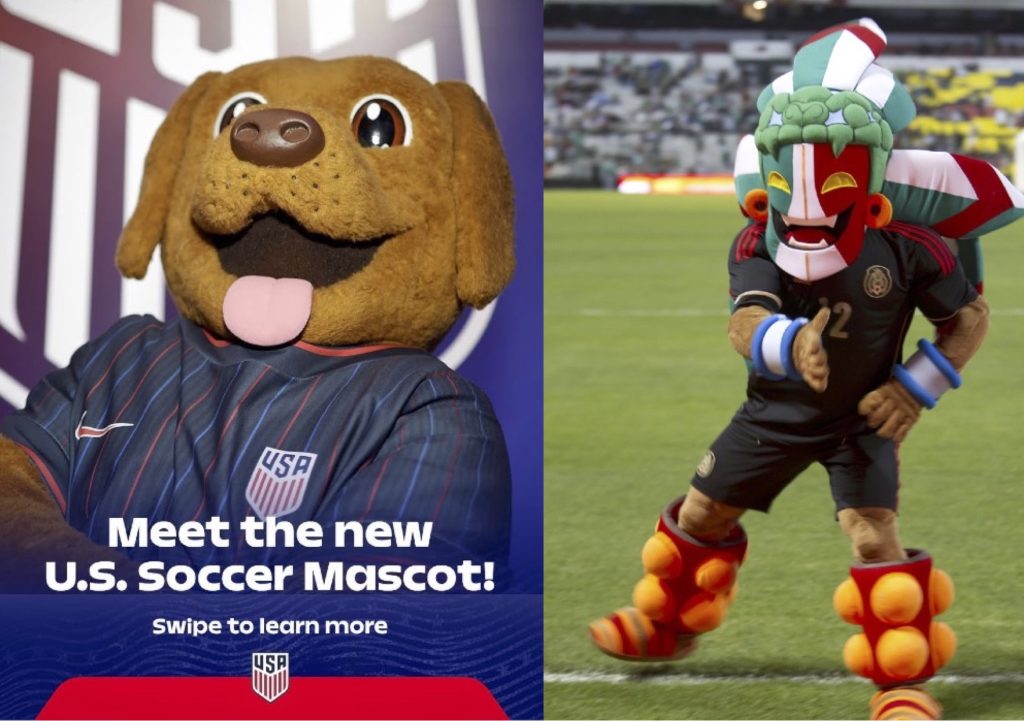
Is there an American Soccer Identity? American fans are working on developing this sense of tribe. And they are following the Mexican example, because our siblings are really good at this: Witness how many American sports fans have adapted wrestling masks to other sporting tribes (like the NFL Broncos, above). Still, while the American federation is busy signing official bourbon deals (Jim Beam), its Mexican counterpart creates team jerseys that further leverage this sense of tribe — in ways that make people actually want to buy them!
It’s fair to point out that Americans are relatively new to this endeavor, so it’s no surprise that a American Soccer Identity remains elusive. In December 2025, the Federation finally announced an official, as-yet-unnamed U.S. national team mascot — along with a nationwide naming contest (get the USSF app to weigh in). Yet the Mexicans generate a new mascot for every World Cup cycle. As part of that process, when they issue these new mascots or uniforms, they lean on the nation’s heritage in ways that would never occur to Americans.
For World Cup 2022, the Mexican away shirt was off-white with pre-Columbian icons — conch shell, spiral staff, fire — stamped in a deep burgundy, “a display of the history, roots, and culture of our country, carrying knowledge and power to the playing fields of Qatar, revealing not only a uniform, but armor filled with magic, power and poetry,” Adidas and the Federación asserted in a joint statement. U.S. Soccer does not issue statements like this. Team USA outfitting is mainly met with yawns. The last visceral response? When it trotted out the infamous 1994 kits. Yeah, the ones with faux denim shorts that everyone hated…
What’s going on here?
This concept of pitting one tribe against another, each one eager to represent and compete on behalf of its own God, Country, and Flag (read: national identity), feels elementally human. But when it comes to sport, the U.S. — a country of pretty expert marketers — is consistently outgunned.
Truth is, the United States is still learning how national team identity works.
In 1989, the USMNT qualified for its first World Cup finals appearance in the modern era. Then, in 1991, the U.S. Women’s National Team wasted no time in claiming the inaugural Women’s World Cup. This sudden rise produced several curious phenomena, the downstream effects of which we still feel today.
Foremost among them: U.S. sporting culture in the 1990s was entirely unprepared to support a national team of any kind, outside the Olympic context. The country’s underdeveloped soccer culture was a big reason why; most countries have a national soccer team, at the very least. Yet we had virtually no experience rooting for national teams of any kind. All of our major sports are entirely domestic. Our rivalries are all city vs. city, or region vs. region. Is it any wonder American Soccer Identity suffers?
USA Basketball’s formation of the NBA Dream Team, which competed at the ’92 Barcelona Olympiad, helped matters a great deal, as did the 1994 World Cup. But in the 21st century, our sporting universe has remained strongly insular. We don’t need to create a national identity in basketball or baseball, for example. Instead, we hold a domestic championship and crown “world” champions.
Accordingly and to this day, the United States lags behind on the national sporting identity front. American soccer fans are very at home referring to the Mexican national soccer team by its beloved, established nicknames, especially El Tri. Thirty-five years into the Modern American Soccer Movement, the USMNT still does not have one for itself, and neither does the world-beating, four-times-crowned USWNT. Team USA and these unwieldy acronyms have been in place since the early 1990s, but they seem to me very ordinary, largely inadequate generics.
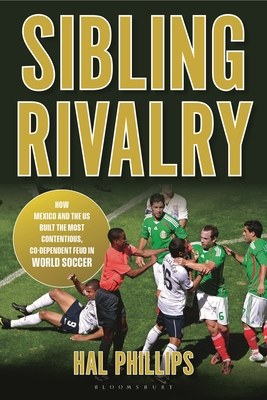
In the pages of “Sibling Rivalry,” the author uses Stars & Stripes and Yanks, but mainly to avoid deploying USMNT and USWNT over and over again. They don’t feel like honest-to-goodness nicknames, not yet, not to this fan. It’s baffling that the U.S. Soccer Federation has so far resisted the solicitation of comparable, identity-promoting national team nicknames — yeah, what it’s finally seen fit to do on behalf of this new canine mascot.
Maybe our nickname void is an indication of just how much we americanos still have to learn about ourselves in the futbol-identity department. Does this country even have a soccer identity? Or do we have so many sporting identities — all of them domestic, regional, and insular — that we don’t know where to begin?
In 1996, ABA Sport rolled out a green Mexican national team uniform overlaid with a zoomed-in stencil of the Aztec calendar, with the sun god, Tonatiuh, dead center — eyes popping and tongue fully extended. Eight of El Tri’s last 18 national team uniforms have featured similar pre-Hispanic markers. Consumers went wild in acquiring them. Here’s a telling stat: As early as 2015, Adidas reported that El Tricolor kit sales in the US matched those in Mexico itself.
We could do the same thing with the U.S. Constitution, I suppose, but we don’t. Mexicans just feel stronger about looking and acting Mexican during international futbol matches, especially installments of the North American Derby. It’s also clear that Americans, who have so little experience thinking about international sport, have leaned disproportionately on US vs. Mexico to learn what much of the world already knows: that national tribe, gathered over and over in support of a national team, doesn’t so much choose supporters as produce them — not just individual fans but the collective.
And that takes time.
In 2026, we’ll see what sort of progress the U.S. has made. Every four years, World Cups give all participating fan bases the means and the opportunity to represent, to show the gathering of tribes what they are specifically about.
“World Cups do provide genuine windows on a country,” says TNT futbol commentator Marion Reimers, who is quoted widely in “Sibling Rivalry”. She points out that Mexico is happy to share the spotlight in 2026. “It’s probably just as well that Mexico will get that exposure — but not have to build any stadiums!”