He’s Not Wrong: U.S. Tends to Hog Regional Branding
He’s Not Wrong: U.S. Tends to Hog Regional Branding
Neil Young first introduced me to appellative “American” chauvinism. Someone (probably a Lynyrd Skynyrd fan) had accused the Canadian guitar god of not being American — as part of the flack Young took for writing and recording the song, “Southern Man”. Neil’s response was quick, pointed and apt: “I’m plenty American: North American.”
It’s been a few days since Bad Bunny made the identical point during the Super Bowl LX halftime show. His messaging — that “America” is a far broader, older, more inclusive label that many U.S. citizens wish to contemplate — also happens to be a stone-cold fact, one that animates the sibling soccer rivalry between the U.S. and Mexico, the prevailing politics north and south of both U.S. borders, and the World Cup all three siblings will co-host this summer.
While Bunny’s elaborate performance proved a clever, gauzy ode to how many different types of Americans can peaceably live within U.S. borders, the linguistic history remains clear and unsentimental. The word “America” was first coined in reference to an Italian, Amerigo Vespucci. It was originally used to identify the northeast coast of Brazil — a reality codified, come 1507, by German mapmaker Martin Waldseemüller. Until 1776, the term had absolutely nothing to do with the United States.
Still, many across The Americas feel as though the U.S. has slowly but surely co-opted the term and hogged the associated identity for itself.
Señor Bunny made this equally clear last Sunday night. The “American” football he toted throughout the halftime production read, Together, we are America. In English, he spoke these words, “God bless America,” before issuing the following roll call, in Spanish: “Chile, Argentina, Uruguay, Paraguay, Bolivia, Peru, Ecuador, Brazil, Colombia, Venezuela, Guyana, Panama, Costa Rica, Nicaragua, Honduras, El Salvador, Guatemala, Mexico, Cuba, Dominican Republic, Jamaica, Haiti, Antilles, United States — not Estados Unidos — Canada, and Puerto Rico.”
Mexicans themselves have been making this point for more than 200 years, as they fought to maintain their sovereignty and identity in the shadow of an aggressive hegemon. They have an aphorism custom-built to describe this struggle: So far from God. So close to the United States.
For more than 100 years, Mexican soccer culture has underlined this grammatical, geographic distinction in fascinating ways. For starters, because they’re Americans, too, they refer to their northern neighbor exclusively as Estados Unidos, and its citizens as estadounidenses.
Consider the name of Mexico’s biggest, richest club, Club América. In choosing this hemispheric moniker, Rafael Garza Gutiérrez and co-founder Germán Nuñez Cortina purposely made a larger, geopolitical point — Bad Bunny’s point — about the United States. By 1917, Big Brother had not yet grown into a global superpower. But it had come to dominate the Western Hemisphere, along with the words “America” and “American.” The club’s chosen identity, then as now, defiantly reclaims a portion of this regional branding.
Most U.S. citizens don’t recognize or appreciate how loudly South, Central, and fellow North Americans condemn gringo appropriation of the “American” designation. Mexican futbol fans may not fully understand the history either. In supporting Club América, however, they do savor the opportunity to redeem the word for Mexican futbol, and themselves.
These feelings go back a very long way. “The U.S.-Mexico War in the 19th century has had big impact on the psyche of Mexico — in many ways, certainly the futbol but very much in terms of America, the word,” says Amy Glover, the U.S.-born CEO and cofounder of Agil(e), a strategic communications firm based in Mexico City. “The British use it a lot, referring to the United States. I read The Economist frequently. They always refer to the country as America, and the Americans, and it’s super annoying. Mexicans find that annoying. I don’t say I’m from America, for example. I usually say I’m from the United States.”
Marion Reimers is a Spanish-language journalist and football commentator for TNT Sports Mexico. She agrees with Glover, and Bunny: This monopolization of specific words and identities doesn’t sit well with the entire hemisphere.
“Absolutely. Not only Mexicans complain about this. I can assure you Chileans, Argentinians, and Brazilians feel the same way. It’s this way in which the U.S. tends to look at its navel and not understand anything that is going on around them. I mean, I’d say this very respectfully, but it’s this tunnel vision that is characteristic of the U.S. And it’s also this very colonialistic way of looking at the world. And no, unfortunately, you’re not the whole continent. You’re just a country. A big country, an important country. But just one of many.”
In Bunny’s case, the history and the law are particularly telling: The U.S. Supreme Court ruled in a 1904 decision (Gonzalez v. Williams) that Puerto Rican-born Isabel González was not an alien and could not be denied entry to the United States. As historian Heather Cox Richardson has written:
“The justices went on to create a new category of personhood for the island’s inhabitants. They were not aliens, but they were not citizens either. Instead, they were ‘noncitizen nationals.’ As such, they had some constitutional protections but not all. They could travel to the American mainland without being considered immigrants, but they had no voting rights in the U.S. Puerto Ricans do pay U.S. Social Security taxes and receive certain federal benefits.”
Folks who opposed Bad Bunny’s Super Bowl halftime performance complained that he wasn’t American, ignoring the legislative reality in their own country — and the fact that foreign performers have consistently appeared in that capacity: Phil Collins, U2, Shania Twain, Sting, Paul McCartney, The Rolling Stones, The Who, Coldplay, Shakira, The Weeknd and Rihanna.
Bunny is clearly American, twice over. He’s also a U.S. non-citizen national.
But here’s what he is not: White.
This racialized reality further informs Mexican ambivalence today, as the current U.S. administration seems determined to appropriate the American designation in word, song, skin color, race and what passes for international law.
Soccer used to be a sanctuary for Mexicans in this regard. For much of the 20th century, the United States proved a hapless minnow that did not meaningfully intrude on the international game. In fact, El Tri, its fans and Mexican media built their national footballing self-image largely on beating the USMNT like a rented mule, over and over again, for decades.
Prior to 1990, Mexico played the role of Big Brother.
The rise of U.S. soccer — men and women, club and country — has changed all that. This evolution has also transformed its competitive futbol standing across The Americas and around the world. But most of all it has uniquely super-charged the U.S.-Mexico relationship. No soccer competition today is so freighted with geo-political, cultural and grammatical baggage. No international clásico is half as complicated, contentious or co-dependent as the North American Derby.
Curiously, U.S.-Mexico has also evolved into much more than a series of national team games. Today, MLS and Liga MX compete for eyeballs and television ratings on the same networks. In the Leagues Cup, started in 2023, they compete as straight-up partners. Controversially, El Tri continues to play most of its international friendlies north of the Rio Grande. And, of course, World Cup 2026 will be co-hosted by Mexico and the United States, along with Precocious Kid Brother Canada — a team that plays under a talented, outspoken U.S. coach, Jesse Marsch, who has forcefully supported the idea that 50 United States are more than enough.
As Bunny has tried to tell us, we should emphasize all this cooperation — all that we share as hemispheric Americans. Like brothers and sisters in a sprawling, intercontinental family drama, by turns dysfunctional and intimate, we need each other. And we’re stuck with each other. Let’s make the best of it.
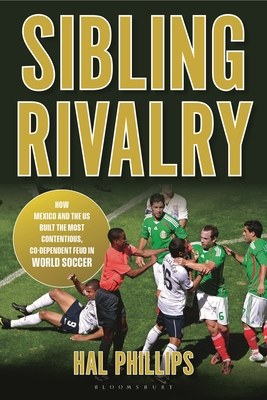
Bio: Hal Phillips is author of Sibling Rivalry: How Mexico and the U.S. Built the Most Contentious, Co-dependent Feud in World Soccer, published by Bloomsbury on 5 March 2026.

